The History of JavaScript
Birth, Growth & Global Dominance.
The Birth of JavaScript (1995)
JavaScript's story begins in 1995 at Netscape Communications. Brendan Eich, a programmer at Netscape, was tasked with creating a scripting language for the company's popular browser at the time, Netscape Navigator. In just 10 days, Eich developed the first version of the language. Initially called “Mocha,” then “LiveScript,” it was eventually renamed JavaScript in December 1995 as a marketing strategy to ride the popularity wave of Java at the time. Despite the name similarity, JavaScript was entirely different, and was designed as a lightweight interpreted scripting language to bring interactivity and ease of use to web pages [35].
Standardization of JavaScript
As JavaScript spread, Microsoft introduced its own implementation in Internet Explorer called JScript. This sparked many incompatibility issues as developers had to write code differently for each browser. To address this chaos, the different browser vendors on the market during that time all agreed to use JavaScript in their browsers. As a result, Netscape submitted JavaScript for standardization in 1997 under the name ECMAScript by the European Computer Manufacturers Association (ECMA) [36]. It is important to note that ECMAScript is not a separate language, but rather a standardized specification that defines how the language works. JavaScript is the most widely used implementation of this standard [37]. This standardization provided consistency across browsers and laid the foundation for JavaScript's long-term growth.
Key Milestones in JavaScript's Evolution
While JavaScript's birth in 1995 and its standardization as ECMAScript in 1997 laid the foundation, the years that followed brought rapid growth and transformation. From enabling dynamic web applications to expanding beyond the browser, JavaScript evolved into a versatile and powerful language. The timeline below highlights some of the most significant updates and milestones from the 2000s onward.
mid 2000s
AJAX Revolution
Allowed web pages to update content asynchronously without reloading. Enabled rich, interactive applications such as Gmail, Google Maps, and Facebook [36].
early 2009
Node.js Release
Extended JavaScript to the server side, enabling developers to use one language for both front-end and back-end programming.
late 2009
ECMAScript 5 (ES5)
Introduced strict mode, JSON support, and improved object handling, making JavaScript more reliable and developer-friendly [36].
2015
ECMAScript 6 (ES6 / ECMAScript 2015)
A landmark update adding classes, modules, arrow functions, promises, and other modern features, supporting large-scale applications [35].
2016-2025
Annual ECMAScript Updates
Shifted to a yearly release cycle (ES2016, ES2017, … up to ES2025), making JavaScript a "living standard" that evolves continuously [38].
Global Dominance
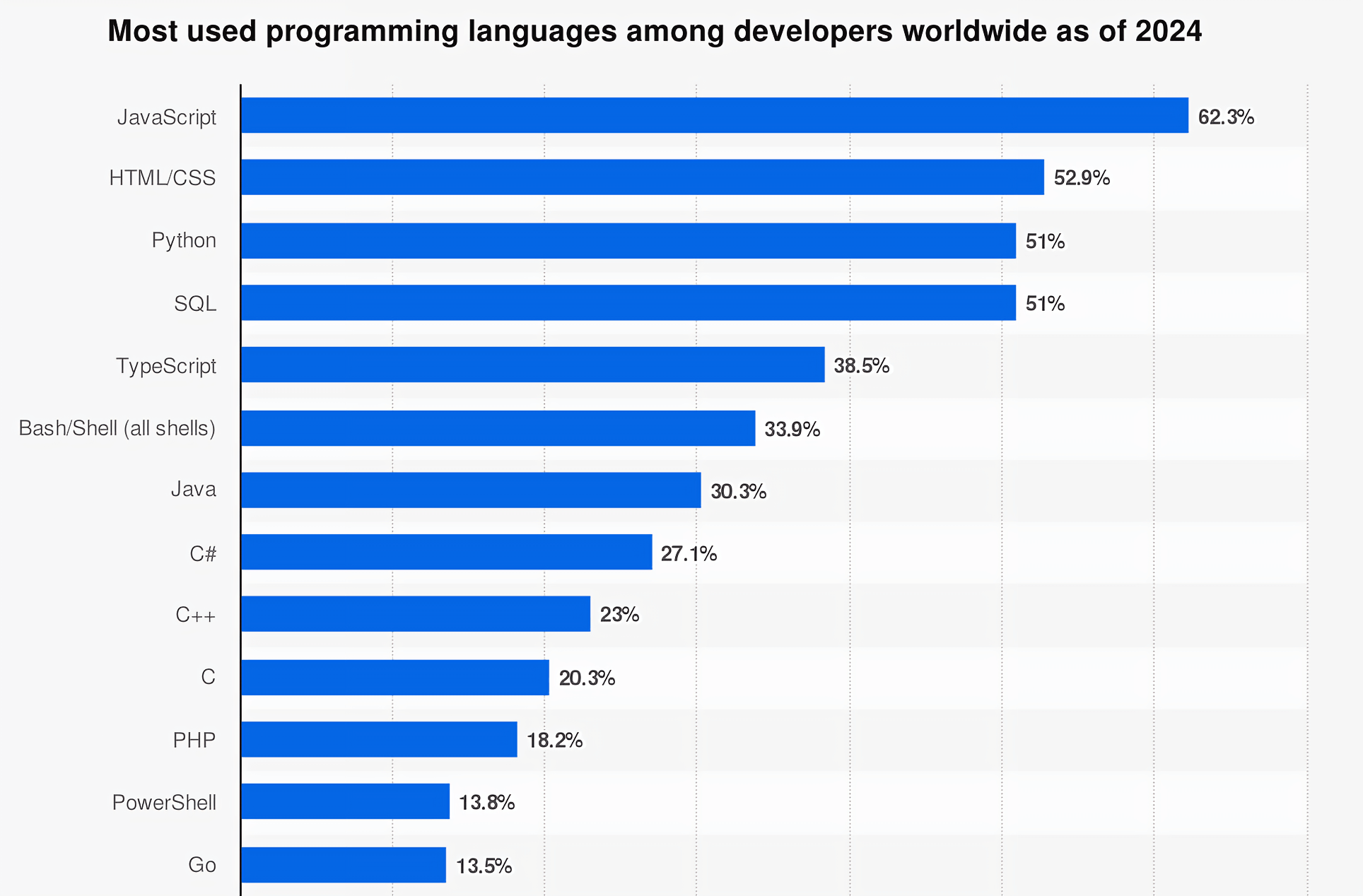
Today, JavaScript is the backbone of the web. It is universally supported by all major browsers and drives countless frameworks and libraries such as React, Angular, and Vue. As of 2025, JavaScript is used by approximately 98.9% of websites, underscoring its immense popularity in web development [39]. The diagram below highlights the prominence of JavaScript, showing its position as the most widely used programming language among developers in 2024.
Notably, JavaScript continues to evolve as a living standard. Each year, a new ECMAScript edition is published, incorporating the latest approved features. As of 2025, the current specification is ECMAScript 2025 (ES2025), which represents the 16th edition of the language [38]. This ongoing process ensures JavaScript remains modern, relevant, and capable of meeting the needs of developers worldwide.
Conclusion
From a rushed project in 1995 to a global standard, JavaScript's growth reflects the evolution of the internet itself. Its adaptability, community support, and continuous updates have secured its place as the world's most essential programming language.